

Choosing between an L-shaped desk and a straight desk is less about which style looks more substantial and more about how the workstation will be used every day. A straight desk keeps work centered on one main surface. An L-shaped desk adds a return that can create a second work zone for paperwork, equipment, reference material or another task.
The better choice depends on the room, the work being done, how much surface area is actually needed and whether the office may need to change later. Before ordering either configuration, compare the footprint, chair movement, nearby storage and the way the user moves through a normal workday.
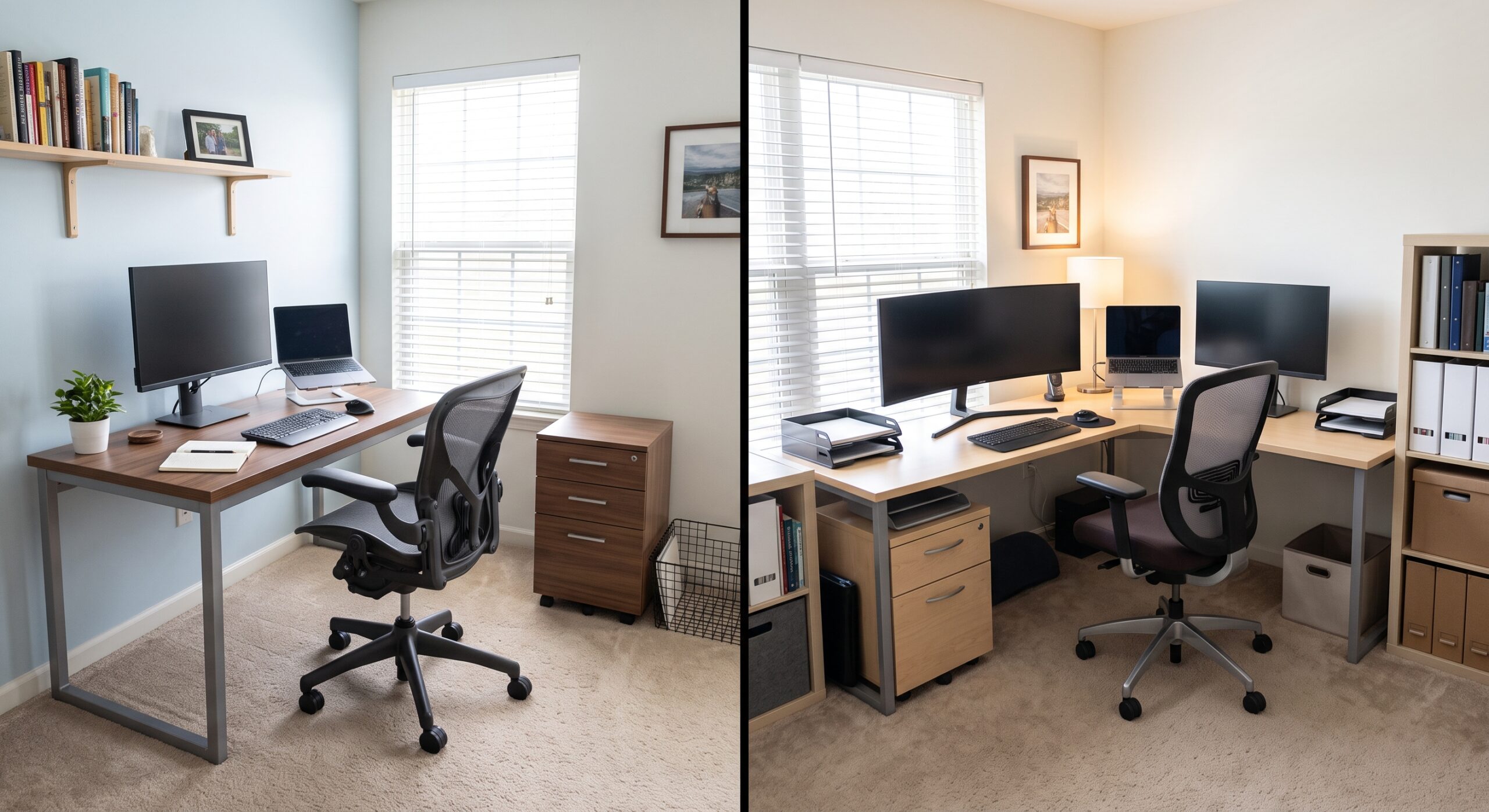
Choose a straight desk when you want a simpler footprint, easier room placement and a workstation that can be moved or reconfigured more easily. Choose an L-shaped desk when the user regularly needs two active work areas and the room has enough space for the main desk, return, chair movement and surrounding furniture.
|
Planning Factor |
Straight Desk |
L-Shaped Desk |
|
Work surface |
One primary work zone |
Two connected work zones |
|
Room placement |
Fits more wall and open-room layouts |
Works best where the return has a clear position |
|
Flexibility |
Easier to relocate or rearrange |
Requires more planning before placement |
|
Paperwork and equipment |
Works well when daily tools fit on one surface |
Useful when separate tasks need to stay open at the same time |
|
Storage pairing |
Pairs easily with mobile or nearby storage |
Can integrate storage across a larger workstation footprint |
|
Best planning question |
Do I need more than one active work zone? |
Will I actually use the return every day? |
A straight desk uses one main rectangular work surface. It can be placed against a wall, near a window, in a private office or as part of a larger workstation plan. Because the footprint is simple, straight desks are usually easier to position around doors, storage, guest seating and circulation paths.
A straight desk works especially well when the user spends most of the day on a laptop or monitor setup and does not need a second surface to keep documents, samples or equipment open at the same time. A pedestal, lateral file or nearby bookcase can add storage without changing the basic workstation shape.
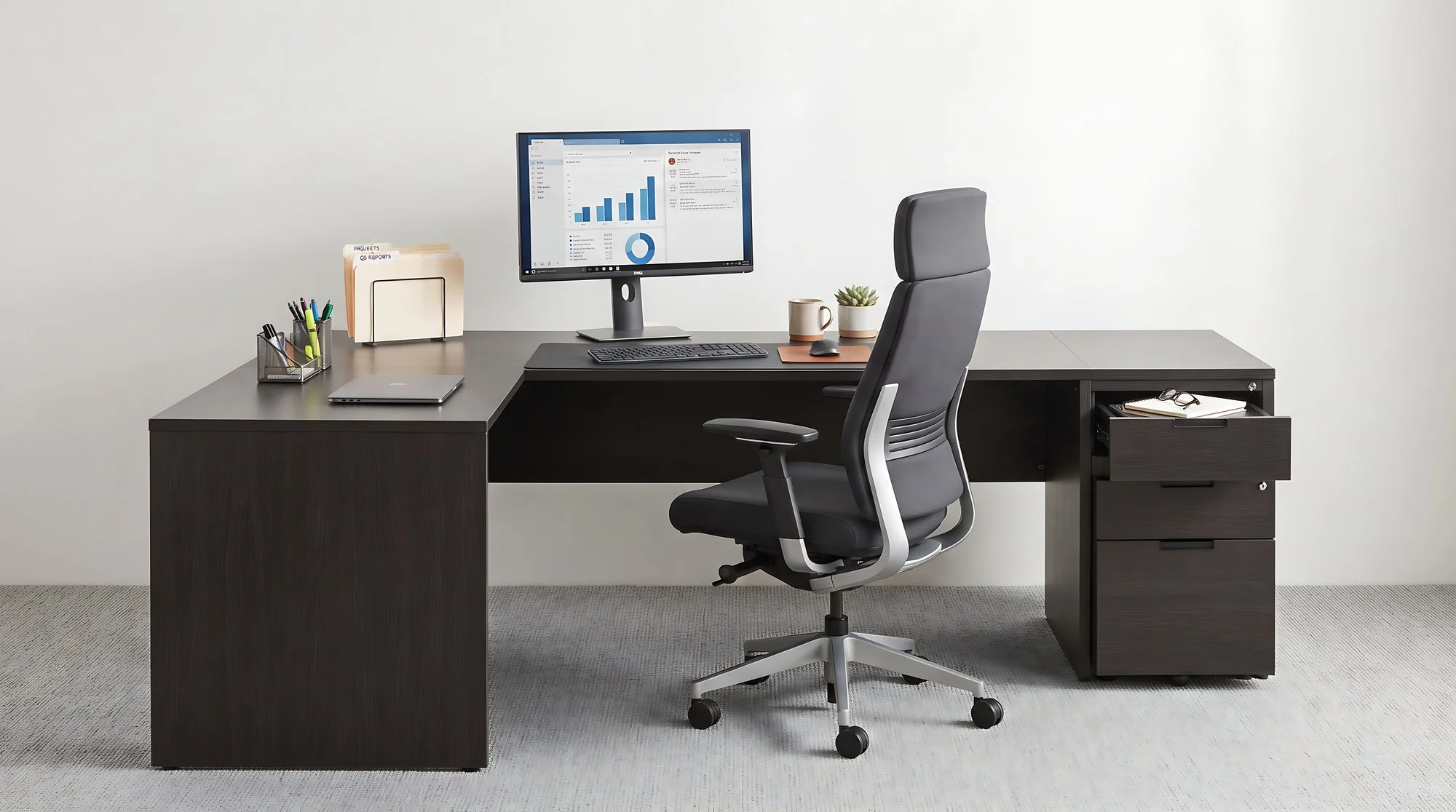
An L-shaped desk combines a primary desk surface with a return that extends to one side. The return creates another reachable work area without requiring the user to move to a separate table or credenza.
That extra surface is most useful when it has a clear purpose. One side might hold the primary computer setup while the other is used for paperwork, a second device, reference materials, samples or another recurring task. If the return is not needed for regular work, it can become unused surface that takes up floor area without improving the workstation.
The most useful way to compare an L-shaped desk vs. a straight desk is to think in terms of work zones. A straight desk concentrates activity in front of the user. An L-shaped desk gives the user the option to divide tasks between two connected surfaces.
For someone who works almost entirely on a computer, that second surface may not add much value. For someone who moves between digital work, paperwork, plans, samples or frequent reference material, keeping both areas available can reduce the need to constantly clear and reset the desk.
A straight desk is generally easier to fit into a smaller or more constrained room because its footprint is simpler. It can sit along one wall and leave more options for guest seating, filing or movement through the room.
An L-shaped desk can still work in a smaller office when the room has a usable corner and the return does not interfere with the door, storage or chair movement. The important point is not to assume that an L-shape automatically saves space simply because it uses a corner. Measure the complete desk configuration and the open area around it before deciding.
Before choosing the larger configuration, list what normally stays on the desk during a workday. A monitor or laptop, keyboard, phone, notebook and a few daily items may fit comfortably on a well-sized straight desk. If the user also keeps drawings, binders, product samples, paperwork or a second work setup open throughout the day, an L-shaped configuration may make the surface easier to organize.
More surface area is useful when it supports the work. It is less useful when it simply creates more room for items that should be stored elsewhere.
Desk shape is only one part of the workstation. Filing and storage can determine whether a straight desk feels adequate or crowded. A straight desk paired with a mobile pedestal, lateral file or bookcase may provide all the capacity a user needs while keeping the room more open.
An L-shaped desk may be the better choice when storage and equipment need to remain within immediate reach across two work surfaces. The finished plan should consider drawer access, cabinet doors and whether the desk return blocks nearby filing furniture.
Internal link: browse filing and bookcases
Straight desks are easier to work into rooms that may change over time. They can be moved to another wall, paired with different storage or used in a different office without requiring the same corner relationship as an L-shaped workstation.
That flexibility can matter in growing businesses, shared offices and spaces where departments or room assignments may change. If the workstation is likely to be relocated, a simpler footprint can make future planning easier.
The return should be treated as a working surface, not simply extra furniture. Before choosing an L-shaped desk, decide what will happen on that side of the workstation.
When the second surface supports a recurring task, the configuration can make the workstation easier to use. When it does not, a straight desk with well-planned storage may be the cleaner choice.
Do not compare desk shapes only from product photos. Record the actual dimensions of the room and the furniture being considered. Then account for everything that competes for the same floor area.
A desk can fit inside the room and still be the wrong size if the user cannot open a file drawer, pull back the chair or move comfortably between the desk and the door.
Either desk type can support multiple monitors when the work surface has enough width and depth. The decision should be based on the rest of the workflow rather than the monitor count alone.
If the screens are the main focus and other materials are limited, a straight desk may keep the setup centered and simple. If the user also needs a separate area for paperwork, another device or reference material, an L-shaped desk can make it easier to divide the workstation into distinct zones.
A home office often has to share space with other household needs, so flexibility matters. A straight desk can be easier to place in a bedroom, den or smaller dedicated office and is usually easier to move if the room changes function later.
An L-shaped desk is useful in a dedicated home office when the user needs more than one active surface and the room has a clear corner for the return. The same rule applies as in a commercial office: choose the shape that matches the work, not simply the largest desk the room can hold.
Commercial offices often need consistency across several work areas. Straight desks can make repeated workstation layouts easier to plan and reconfigure. L-shaped desks may be better suited to private offices or roles that require more surface area and task separation.
A mixed furniture plan can also make sense. Not every employee needs the same desk configuration. Using the work being performed, room dimensions and storage requirements as the decision criteria can prevent over-furnishing some areas while leaving others short on usable workspace.
|
Work Pattern |
Likely Better Starting Point |
Why |
|
Mostly computer-based work |
Straight desk |
Keeps the main work zone centered and simple |
|
Computer work plus daily paperwork |
L-shaped desk |
Creates a second active surface without adding a separate table |
|
Small room with changing needs |
Straight desk |
Allows more placement and future reconfiguration options |
|
Dedicated private office with multiple task zones |
L-shaped desk |
Provides connected surfaces for different recurring activities |
|
Shared or repeat workstation layouts |
Straight desk |
Simplifies consistent planning across several stations |
An L-shaped desk can look impressive in a large showroom or product image and still overwhelm a smaller office. Always work from actual dimensions.
Extra surface helps only when it supports a recurring task. Otherwise, it can reduce open floor area and encourage clutter.
The user needs room to sit, turn and move away from the desk. Check the desk and chair together rather than treating the chair as an accessory that can be added later.
A return, pedestal or nearby cabinet can create conflicts if drawers and doors do not have enough clearance. Test the complete workstation plan, not just the desk outline.
A consistent look does not require every role to have the same footprint. Different work patterns may justify different desk configurations within the same furniture program.
The live 309 Office Furniture desk collection includes L Shape Desk options along with writing desks, pedestal desks, desk shells, reception configurations and sit-stand desks. Comparing these formats in the context of your room can make it easier to judge scale, surface area, storage and how each desk will work with the rest of the office.
Explore the current selection: browse office desks
For offices in Hatfield and elsewhere in Pennsylvania, seeing furniture in person can also help when finishes, chair fit and the overall workstation footprint are difficult to judge online.
Not automatically. An L-shaped desk is a stronger fit when the user genuinely needs two active work surfaces. A straight desk is often the better choice when one work zone is enough and flexibility or room space is more important.
Yes, when the room has a usable corner and enough clearance for the return, chair and surrounding furniture. Measure the complete layout before assuming the corner configuration will fit.
It can be. Monitor count alone does not determine the desk shape. Check the actual desk width and depth, then consider whether the user also needs a separate area for paperwork, equipment or other daily tasks.
A straight desk generally has a simpler footprint and is easier to place in a different room or layout. L-shaped desks require more attention to the position and orientation of the return.
The best desk configuration is the one that supports the work without taking more room than necessary. Start with the tasks performed every day, then compare the amount of surface area, storage, chair clearance and room flexibility each desk provides.
A straight desk is a practical starting point for focused work and flexible layouts. An L-shaped desk becomes the stronger choice when a second active work zone is genuinely useful and the room can support the larger configuration.
Compare desk configurations, office chairs, storage and other workspace furniture at 309 Office Furniture & Design in Hatfield, Pennsylvania.
1711 Bethlehem Pike, Hatfield, PA 19440
(215) 822-3333